
What Skills Do Students Develop in Year 11 That Prepare Them for Life After School?
Year 11 is more than a preparation year for the HSC. It is also a period when students begin developing the academic, organisational, communication and personal skills they will need beyond school. From managing competing deadlines and working independently to making informed decisions about future pathways, Year 11 can help students become more confident and capable learners.
For students in NSW, Year 11 marks the beginning of Stage 6 and introduces greater academic responsibility. Students have more influence over their subjects and future direction, while also learning how to manage the expectations that come with senior secondary education.
These skills can become valuable well beyond Year 12, whether a student moves into university, TAFE, vocational training, an apprenticeship, employment or another pathway.
What skills do students develop in Year 11?
Students can develop a wide range of skills during Year 11, including:
- Time management
- Independent learning
- Organisation
- Critical thinking
- Communication
- Research skills
- Problem-solving
- Decision-making
- Goal setting
- Resilience
- Self-awareness
- Collaboration
- Adaptability
The importance of Year 11 is therefore not limited to academic results. It can also be an opportunity for students to understand how they learn, how they work and what they want to achieve after school.
1. Time Management
One of the biggest changes students experience in Year 11 is learning to manage their time more independently.
Senior students may have several subjects, assignments, assessments, extracurricular activities and personal commitments happening at the same time. Instead of relying entirely on teachers or parents to organise everything, students increasingly need to take responsibility for their own schedules.
This can involve:
- Recording assessment dates.
- Breaking large assignments into smaller tasks.
- Planning revision.
- Allowing time for extracurricular commitments.
- Setting priorities.
- Avoiding leaving work until the last minute.
Learning these habits in Year 11 can provide a useful foundation for life after school.
At university, in vocational education or employment, people are often expected to manage multiple responsibilities without someone constantly reminding them what needs to be done.
2. Independent Learning
Year 11 students are expected to take greater ownership of their learning.
This does not mean they are expected to work without teachers or support. Rather, students increasingly need to understand what they need to learn and take initiative when they need help.
Independent learning can include:
- Reviewing class material.
- Completing additional practice.
- Reading beyond the minimum requirements.
- Identifying areas that need improvement.
- Asking questions.
- Acting on teacher feedback.
- Preparing for assessments without waiting for constant reminders.
These habits can become particularly valuable after Year 12.
University students, apprentices and employees all encounter situations where they need to learn something independently. Developing this mindset during Year 11 can make the transition beyond school less daunting.
3. Organisation
Organisation is closely connected to successful senior schooling.
Students may need to keep track of subject materials, assessment tasks, notes, deadlines and study plans across several different courses.
Developing a reliable organisational system can help students reduce unnecessary stress and make their workload more manageable.
For example, students might learn to:
- Keep a calendar of important dates.
- Organise digital and physical resources.
- Record assessment requirements.
- Prioritise urgent tasks.
- Plan ahead for larger projects.
- Review what has been completed and what remains.
These are practical skills that can transfer directly into further study and working life.
4. Critical Thinking
Year 11 is also a time when students encounter more complex questions and concepts.
Rather than simply remembering information, students are often expected to analyse, evaluate, interpret and apply knowledge.
Critical thinking may involve asking:
- What evidence supports this idea?
- Is this source reliable?
- Are there alternative explanations?
- How does this information relate to the question?
- What conclusions can be drawn?
- What are the strengths and limitations of an argument?
These skills are useful in almost every area of life.
Whether someone is evaluating information online, making a financial decision, researching a university course or solving a workplace problem, the ability to assess information carefully can make a significant difference.
5. Research Skills
Research becomes increasingly important during senior secondary education.
Students learn how to locate relevant information, evaluate sources, identify useful evidence and use information appropriately in their work.
Good research involves more than simply searching online.
Students can learn to:
- Identify appropriate sources.
- Compare different sources.
- Distinguish evidence from opinion.
- Record useful information.
- Reference sources appropriately.
- Build an argument from evidence.
- Communicate research findings clearly.
These skills can support students in university and vocational study, but they are also increasingly relevant in modern workplaces where employees need to find, assess and communicate information.
For students, Year 11 can be a useful opportunity to develop these habits before the greater demands of Year 12 and life beyond school.
6. Communication Skills
Communication is another important skill students develop throughout senior school.
Students may communicate through:
- Written assignments.
- Presentations.
- Group projects.
- Classroom discussions.
- Emails.
- Interviews.
- Debates.
- Practical activities.
Effective communication means more than knowing what to say. Students also learn how to explain ideas clearly, listen to others, adapt their communication to different situations and respond appropriately to feedback.
These abilities can be valuable regardless of a student's eventual career.
An engineer, teacher, healthcare professional, business owner, tradesperson, designer or researcher all need to communicate effectively.
7. Problem-Solving
Year 11 can give students opportunities to move beyond simply finding the correct answer and instead consider how to approach a problem.
Problem-solving involves identifying the issue, considering possible approaches, testing ideas and learning from mistakes.
Students may encounter this process through:
- Mathematics.
- Science experiments.
- Research projects.
- Technology subjects.
- Humanities assignments.
- Creative projects.
- Group activities.
The important lesson is that not every problem has an immediate solution.
Learning to remain patient, try different approaches and respond to setbacks can become a valuable skill for further study and employment.
8. Decision-Making
For many students, Year 11 is also when future decisions start becoming more concrete.
Students may begin considering:
- University courses.
- TAFE.
- VET pathways.
- Apprenticeships.
- Employment.
- Further training.
- Gap-year options.
- Career interests.
Making these decisions requires students to understand their strengths, interests and goals.
They also need to learn that choosing a pathway does not necessarily mean having every aspect of their future mapped out.
The process of researching options, asking questions, comparing alternatives and making informed choices is itself an important life skill.
At Bishop Druitt College, career pathways support includes guidance around university, TAFE, VET, apprenticeships, work experience, internships, industry visits and other opportunities. This broader approach can help students connect their school experience with possible futures.
Year 11 is also an important time for students to begin thinking about how their education connects with future study and employment. The NSW Department of Education highlights the importance of career and study pathways, including helping students develop skills for career planning, decision-making and the transition from school to work. Its Stage 6 Work Studies program specifically focuses on preparing students for the transition from school to work and developing skills needed for career planning and workplace tasks. NSW Department of Education – Work Studies and Work Education
9. Goal Setting
Year 11 provides an opportunity for students to start setting meaningful academic and personal goals.
A goal might be related to:
- Improving performance in a particular subject.
- Establishing a consistent study routine.
- Completing assignments earlier.
- Becoming more confident with presentations.
- Developing a particular skill.
- Exploring a career interest.
- Preparing for a particular post-school pathway.
The process is just as important as the final goal.
Students can learn to set realistic objectives, monitor their progress and adjust their approach when something is not working.
This creates a mindset that can continue into university, employment and adult life.
10. Resilience and Learning From Setbacks
Senior school does not always go perfectly.
Students may receive a lower mark than expected, struggle with a particular subject, miss a deadline or discover that a study strategy is not effective.
These experiences can provide opportunities to develop resilience.
Resilience does not mean never struggling. It means learning how to respond when something does not go according to plan.
A student might learn to:
- Ask for help.
- Review what went wrong.
- Change their study strategy.
- Accept constructive feedback.
- Try again.
- Set a new goal.
These experiences can help students understand that mistakes and setbacks can be part of learning rather than a reason to give up.
11. Self-Awareness
Year 11 can also help students understand themselves as learners.
Students may begin to recognise:
- Which subjects they enjoy.
- Which learning strategies work best for them.
- When they are most productive.
- Where they need additional support.
- What environments help them concentrate.
- Which areas they would like to explore further.
This self-awareness can help students make better decisions about future study and career pathways.
It can also help them understand when they need to change their approach rather than simply working harder.
12. Collaboration and Working With Others
Although senior schooling includes substantial independent work, collaboration remains important.
Students may need to work with classmates on projects, practical activities, performances, discussions and other tasks.
Collaboration teaches students how to:
- Share responsibilities.
- Listen to different perspectives.
- Contribute ideas.
- Resolve disagreements.
- Meet shared deadlines.
- Support other people.
- Take responsibility for their part of a project.
These are directly transferable workplace skills.
Most careers involve some form of teamwork, even when individuals have different responsibilities.
13. Adaptability
The world students enter after school may not look exactly like the world they expected when they started Year 11.
Technology changes. Industries change. Career opportunities evolve. Personal circumstances can change too.
Learning to adapt is therefore an important part of preparing for the future.
Students who become comfortable with learning new skills, changing strategies and responding to new situations may be better prepared for environments where there is no single fixed pathway.
This is particularly relevant when students consider their options after Year 12.
A student's first decision after school does not necessarily determine their entire career.
How Year 11 Can Prepare Students for Life Beyond School
The skills developed during Year 11 can be viewed as a progression.
Schoolwork → Independent responsibility → Further study/work → Lifelong learning
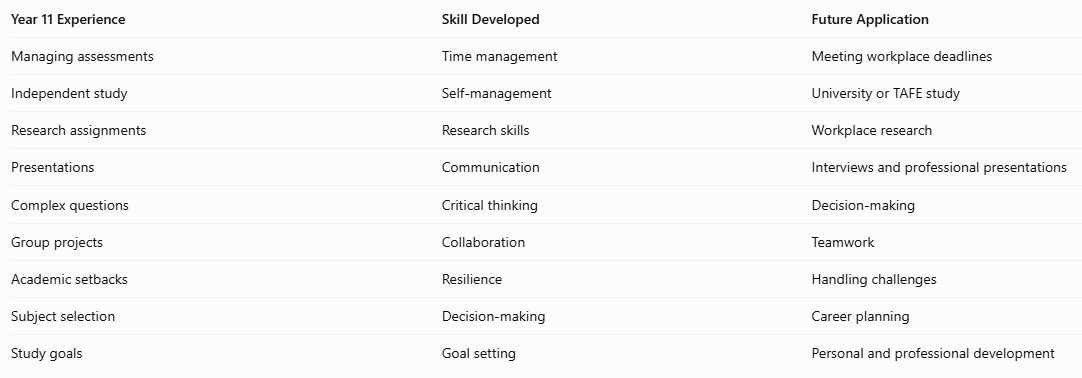
This is why Year 11 should not be viewed solely as a stepping stone to the HSC.
It can also be a period when students begin developing the habits and capabilities that will shape how they approach opportunities and challenges after school.
Why Support Matters During Year 11
Developing these skills does not mean students should be expected to figure everything out independently.
The transition into senior school can involve significant academic and personal changes.
Students benefit from teachers who know their learning needs, pastoral care, opportunities to ask questions and guidance around future pathways.
At Bishop Druitt College, Senior School combines academic learning with pastoral care, wellbeing, career guidance, co-curricular opportunities and pathways planning.
For students who need a different approach to traditional schooling, BDC Horizon Online also provides a flexible online pathway for Years 7–12. Its senior program combines specialist teaching, live online lessons, independent study, digital resources and academic and pastoral support.
This can be particularly relevant for students whose circumstances mean they need greater flexibility while continuing their secondary education.
Year 11 Is About More Than Marks
Academic results are an important part of senior schooling, but they are not the only outcome.
A successful Year 11 student is also developing the ability to:
Manage their time.
Think critically.
Work independently.
Communicate clearly.
Solve problems.
Make informed decisions.
Set goals.
Respond to setbacks.
Work with others.
Understand themselves as learners.
These capabilities can continue to develop throughout Year 12 and beyond.
The goal is not to have every aspect of life after school decided by the end of Year 11. Instead, students can use this stage to build the confidence, independence and practical skills they need to make informed choices about their next steps.
Frequently Asked Questions
Why is Year 11 important for students?
Year 11 begins Stage 6 and introduces students to greater academic responsibility while preparing them for Year 12 and the HSC. It can also help students develop important skills such as organisation, time management, independent learning and decision-making.
What life skills do students develop in Year 11?
Students can develop time management, organisation, communication, problem-solving, critical thinking, resilience, collaboration, goal setting and independent learning skills.
Does Year 11 help students prepare for university?
Yes. The increased academic responsibility of Year 11 can help students develop habits that are useful for further study, including managing deadlines, researching information, studying independently and responding to feedback.
How can Year 11 help students prepare for employment?
Year 11 can help students develop transferable skills such as communication, teamwork, problem-solving, organisation, adaptability and time management. These skills can be useful across many different workplaces.
Should students know their career path in Year 11?
Not necessarily. Year 11 can be a useful time to explore interests and research possible pathways, but students do not need to have their entire future decided. Career guidance and exposure to different pathways can help them make informed decisions.
How can parents support a Year 11 student?
Parents can encourage students to take increasing responsibility for their study while remaining available to provide support. Helping students establish routines, discuss goals, manage competing commitments and seek help when needed can be valuable.
Can students develop these skills through online schooling?
Yes. Flexible online schooling can provide opportunities for students to develop independent learning, time management, organisation and communication skills. A structured online school should also provide teacher guidance, academic support and clear expectations.
What are the most important skills to develop before leaving school?
There is no single list that applies to every student, but transferable skills such as communication, critical thinking, organisation, problem-solving, independent learning, resilience and adaptability can provide a strong foundation for life after school.
Preparing Students for What Comes Next
Year 11 is an important stage in a student's education because it sits between the foundations of secondary school and the increasing independence of life beyond it.
At Bishop Druitt College, students are supported through their Senior School years with academic learning, wellbeing, career pathways and opportunities to explore interests beyond the classroom. Students can use Year 11 not only to prepare for the HSC, but also to become more independent, capable and confident in making decisions about their future.
The skills students build in Year 11 can last well beyond the final school bell.

As we all gather and stand upon Country, may we acknowledge and respect Gumbaynggirr Land and the thousands of years’ worth of both physical and spiritual connection to Country, culture and teachings embedded forever within these Lands.